
As soon as I scan and upload the PDF, I'll let you know!
There's an excellent foldable for a more in depth look at the coordinate plane. And I believe Math=Love has typed it up.


I have found that I have success in teaching when I am able to present a concept properly to the students with full definitions, correct vocabulary, and examples outlined with strategy. I leave nothing questionable or allow something to be called "that thing". I have also learned that if a strategy, method, object, concept, term etc., has a name, students learn, relate, retain, and apply them more.
This technique is very easy for me in Geometry. Geometry is my specialty to teach; however, Algebra 1 has been a nightmare.
Key problem: I teach kids how to do the math and then they ask me WHY?
And I can't answer them because sometimes I don't know why. I never questioned what I was taught; it's just how you do the math. This needs to change.
My goal this year has been to raise my skill level in teaching Algebra 1 to my skill level of teaching Geometry. It has been slow. I am extremely behind. There's no excuse. And I'm freaking out! But there are positive results. My students understand and use what I have taught them. Some of the most difficult concepts for me to teach, have become easier and more approachable. I'm beginning to see the flow of Algebra 1 and how it builds upon each concept. With Geometry, it just clicked. The struggle I've had with Algebra 1 has been the sequence. I've asked, and I couldn't find an answer. This year, I decided to pick up the textbook as my core resource pulling in CSCOPE materials, EOC prep materials, and other supplemental materials.
This is a look at our journal for the first semester. We haven't even made it half way through the journal!

Here's one area that has kicked my tush every time I try to teach it: Simplifying Algebraic Expressions. When it arrived on the horizon, I spent a large amount of time researching other teachers' strategies. I typed up my journal page pulling information from the textbook along with thoughts found on Math=Love. I liked how she took the time to define each part and show how the term can be expanded and seen in different ways. This made a difference, and answered several questions from students throughout the unit. The definition of combining like terms was referenced multiple time. For instance, a student wanted to change the exponent when adding x and x to x squared. I refered the student to the definition followed by guiding questions.
Another strategy/activity I loved was "Sorting Like Terms". A colleague of mine writes pairs of terms on cards and students have to decide on Like or Unlike and justify.
Here's my journal page on Simplifying Algebraic Expressions.


When we got to the example adding distribution into the mix, we discuss the operations behind distribution and combining like terms and then determine the proper order based on GEMDAS.
And I love when some student says "you do the parenthesis first". That drives me crazy!!!!! We analyze that comment and what it really means in relation to GEMDAS and what operation distribution represents.

Instead of dropping one practice assignment on my students, I have three different assignments spread out over a week that we keep going back to. This helps them review and retain the skills of combining like terms. I want them comfortable and confident with this skill. Kuta Software has multiple practice pages and at different levels. There skills are improving!!
The hardest, worst page in the journal!!!! I have to show my sarcasm sign to my students after I say this.


Reason: To justify and give that "understood one" meaning and a mathematical reference.
We reviewed methods of divisibility earlier in the year in Pre-Algebra.

I like to share different ways to think about divisibility and prime numbers. Students tend to choose a method use it. I enjoy watching them share and teach each other. (The more different the approach, the deeper the knowledge will become.)


We had reviewed the Distributive property earlier in the year.

My students love distributing the b and making "ba+by" and distributing the c to make "ac+dc".

Another part of the distributive property is reviewing its use in mental math. Some of my students have fun using the strategy throughout the year to beat others that use a calculator.


I have found that even after defining these two properties, students do not really recall or understand them. I added these four practice problems and focus the guiding questions on which method would be easiest or most appealing for mental math.

After we worked through the above problems, students were able to identify the properties when asked and even identified them when they were applied later on.
This year, we worked on translating from words to math at differing levels. We began with the basics earlier in the year.
Writing Variables and Expressions


Then we defined and compared expressions to equations on a journal page.
Next, we practiced writing equations with basic terminology.
Writing Equations


Then we added some more operation and words to our arsenal of writing algebraically.
Translating from Words to Math
(This page brought in square, square root, cube, absolute value, and multiple steps.)


Yes, I know it's morbid, but you know what? It stuck!! The kids remember DEAD MAN and what he is used for.
I originally used 'sleepy man' for multiplying and dividing integers, and I couldn't figure out why they were getting hime confused with adding and subtracting. That is until someone suggested a name change because student were probably relating 'sleepy' with subtraction. And they were right!! So, his name changed to DEAD MAN and if confusion arises it is quickly and easily redirected in relation to the letters of the name and operations.
This page of notes opens up and down from that middle squiggly line.

Under the top, three properties are listed as quarter sheets folded in half.

The bottom half is used for additional example and my favorite challenge.

This challenge really made students think about and use the Dead Man tool. We then used calculators to store the values 1, -1, and 0 for p, n, and z to check their answers. If they missed one, they really worked hard to figure out why.

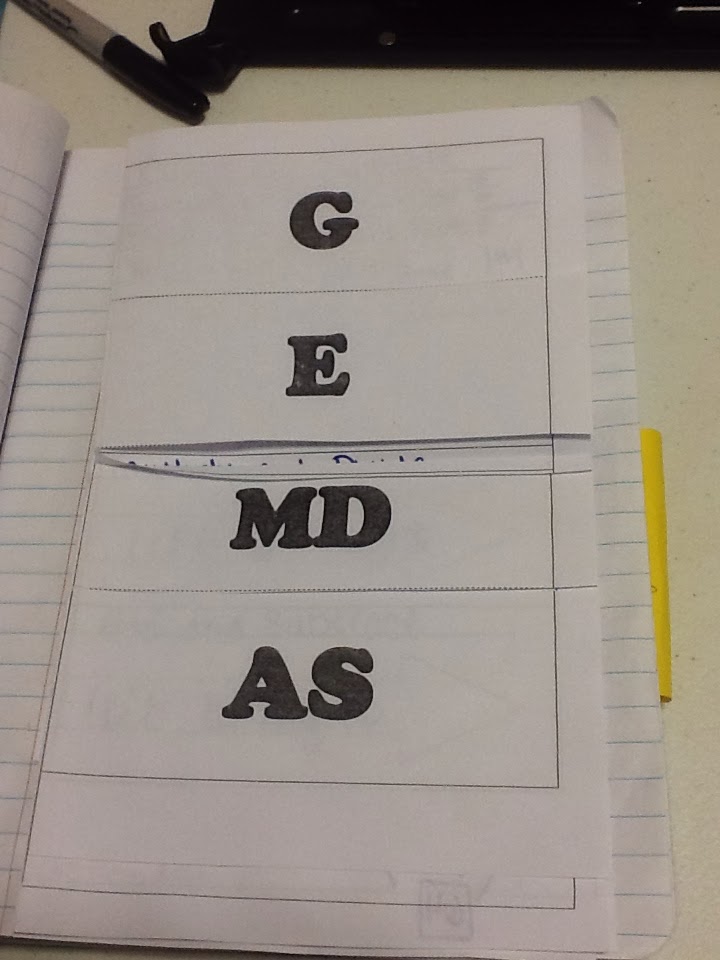
I still used GEMDAS. The kids have responded well to it.

The bottom half is a page folded into fourths and glued down. This quarter fold page contains GEMDAS and what each letter represents.

My journal pages are a compilation of notes, foldables, and practice problems.


Click the tab of the top titled PDF Documents to get a copy.
 Posted with Blogsy