
A year ago today, I began sharing my experience with journaling and education. I have been given the privilege of giving another presentation at the Math and Science Symposium.
I wanted to share the material I presented. I selected several foldables by other bloggers to show that the material I use daily doesn't come from just me. My top Algebra resource is Math=Love.
I'm really proud of myself. Over this past year I have prepped more of my foldables and notes on the computer to cut time in class and presentations.
I have uploaded all but one of the pieces to as a PDF to my google drive. This google drive is shared with the public. It has the PDFs from not only my presentation but also almost everything else I have put together with my computer-bathroom passes, syllabi, journal notes, Spencer Henry Behavioral Management, etc.
I like to start classroom journals and presentations with a tangram puzzle.

All journals and presentations also include what I call a reference pocket on the inside left cover. This is where reference charts for standardized testing, calculator guides, etc. are kept. For presentations, this is where I place my "Journal Wizard" brochure.

Next thing that comes up in journals is a "Unit Pocket" that procedes a definite section of material. I also use journals for professional development.

The next page presented showed how a general page appears in our journals.

The left side is used for two main parts-lesson frame/objective and critical writing/reflection. This has been something I have been striving to complete in journaling. Providing students with a direct objective and incorporating writing and reflections. I'm still struggling to make this a routine in my daily teachings.
I use the right side for the lessons, foldables, assignments, etc. There are other methods suggested such as putting the writing on the left and the lesson material on the right.
I found it very beneficial this year to go over sets of real numbers. This is not a concept that is directly assessed on any standardized testing, but it is apart of the language that is used and seen.

I have seen and used a Venn diagram format in the past, but I really like to do a flip style foldable to make this concept more interactive. Math=Love has a printable format without the flaps.


It's not prefected but it is a start.
Next page: Function Machine
I find it very important to demonstrate what a function is when refered to as a machine.
I use this Youtube video "Meat-A-Morphosis" to introduce functions. The kids get a kick out of it!
I tried to put the idea of a function machine into a pull tab foldable.


Then pull the green tab down to demonstrate the input of six and the ouput result.

Next up is a foldable that I spent hours trying to get the shape placement right. It is still not perfect, but demonstrates the relationship between the most popular quadrilaterals. The only one that I couldn't work in was a rhombus even though a square is a rhombus. This foldable can make a square, rectangle, right angle trapezoid, isosceles trapezoid, and parallelogram. If you would like a copy in Word to perfect the arrangement, send me an email and I'll send you a copy. Just be sure to share it back. :)


The next foldable is a steal from Math=Love. I typed it up completely to progress the pace of my presentation and provide a quick reference for Algebra 2 students. I can share this by email also so it can be edited.


I love this foldable on the Coordinate Plane. I adapted an idea from Region 15 consultant Marifrances and Math=Love posted a template for it. This can be created without a template by first cutting a square, second folding into sixteen squares, third cutting off each corner, and fourth cutting the two squares around the edge into two flaps.


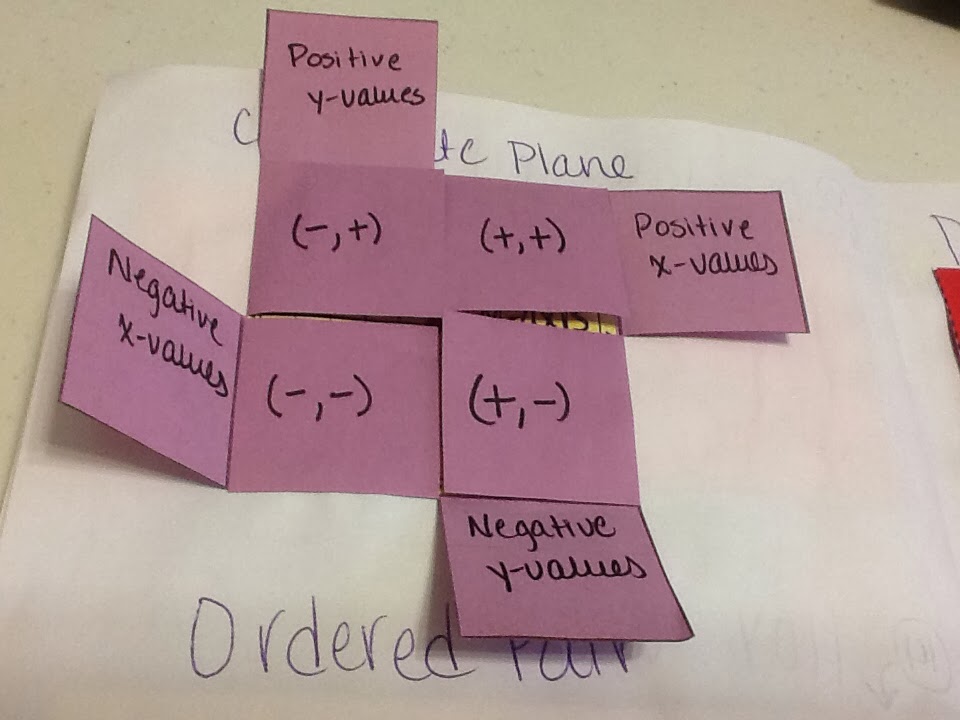

The next foldable is for ordered pairs. I would look on Math=Love for a better illustration of how she taught and used it. I haven't used this in class yet and I ran out of time for my presentation.


Next up, Domain and Range. This is quickly becoming my new favorite thing to teach. Domain and Range was one concept that I didn't get until I started teaching. I struggled through college and had no idea what it was in high school.
I borrowed this acronym from Math=Love and turned it into a similar foldable as HOY VUX.
I pair this foldable that defines Domain and Range with one that is used as a tool for identifying the Domain and Range of a graph.


Thank you for your time! Share thoughts and comments!! It's been a wonderful year and still psyched to keep sharing.
 Posted with Blogsy


