Tuesday, January 7, 2014

Distributive Property

We had reviewed the Distributive property earlier in the year.

My students love distributing the b and making "ba+by" and distributing the c to make "ac+dc".

Another part of the distributive property is reviewing its use in mental math. Some of my students have fun using the strategy throughout the year to beat others that use a calculator.


Commutative and Associative Properties


I have found that even after defining these two properties, students do not really recall or understand them. I added these four practice problems and focus the guiding questions on which method would be easiest or most appealing for mental math.

After we worked through the above problems, students were able to identify the properties when asked and even identified them when they were applied later on.


Sunday, January 5, 2014

Translating from Words to Math

This year, we worked on translating from words to math at differing levels. We began with the basics earlier in the year.

Writing Variables and Expressions


Then we defined and compared expressions to equations on a journal page.

Next, we practiced writing equations with basic terminology.

Writing Equations


Then we added some more operation and words to our arsenal of writing algebraically.

Translating from Words to Math

(This page brought in square, square root, cube, absolute value, and multiple steps.)


DEAD MAN (say bye to sleepy man!)

Yes, I know it's morbid, but you know what? It stuck!! The kids remember DEAD MAN and what he is used for.

I originally used 'sleepy man' for multiplying and dividing integers, and I couldn't figure out why they were getting hime confused with adding and subtracting. That is until someone suggested a name change because student were probably relating 'sleepy' with subtraction. And they were right!! So, his name changed to DEAD MAN and if confusion arises it is quickly and easily redirected in relation to the letters of the name and operations.

This page of notes opens up and down from that middle squiggly line.

Under the top, three properties are listed as quarter sheets folded in half.

The bottom half is used for additional example and my favorite challenge.

This challenge really made students think about and use the Dead Man tool. We then used calculators to store the values 1, -1, and 0 for p, n, and z to check their answers. If they missed one, they really worked hard to figure out why.


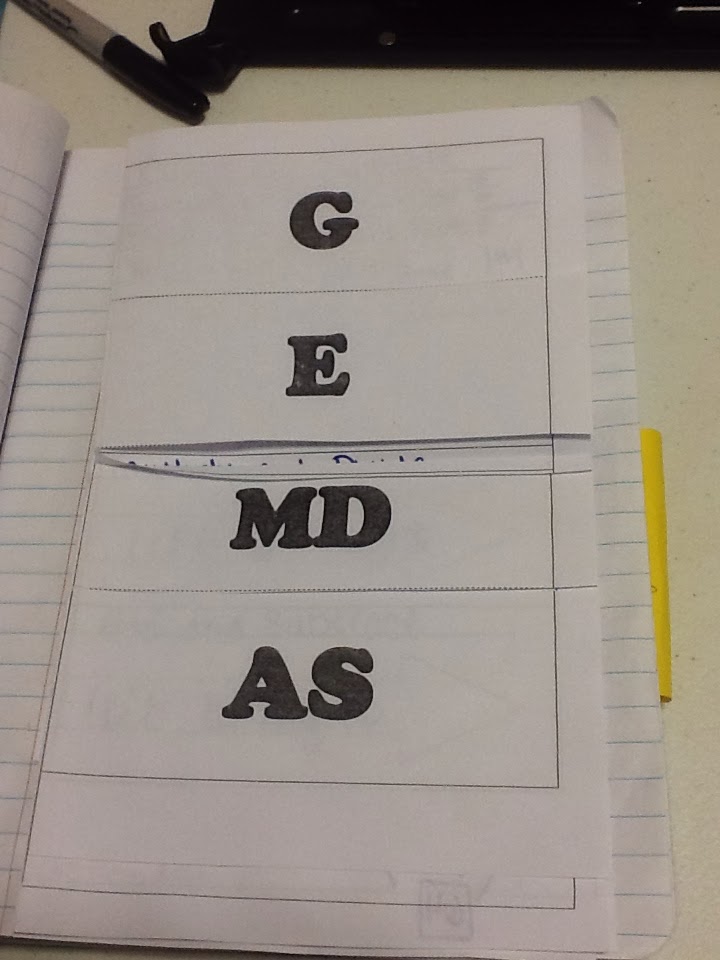
Order of Operations GEMDAS

I still used GEMDAS. The kids have responded well to it.


The bottom half is a page folded into fourths and glued down. This quarter fold page contains GEMDAS and what each letter represents.


My journal pages are a compilation of notes, foldables, and practice problems.


Click the tab of the top titled PDF Documents to get a copy.


Printable Journal Notes

Some colleagues and students have requested typed notes. I have been slowly working on typing old notes. This is not my go-to strategy. I'm very hands-on and pen to paper.

My journal notes strategy or folding method is simple once you figure out my pattern.

They will not print perfectly or fold exactly!

Most all notes are folded in half (half page folds are what I call them). And I'm very proportionate as far as dividing things in half, fourths, sixths, eighths, etc.

Printing: The first two pages of notes (not including attached notes/foldables by glue) are to be printed two sided. I change the print setting on my computer to two sided flip on short edge. A colleague of mine, prints them one sided and then figures out the two sided at the copier. Each additional page to be attached is printed one sided. Some people claim it as a waste; however, I have a ton of scratch paper with one blank side that I run through the copier for these notes.

Attached notes/foldables that are glued to the half page notes are usually a two sided print.

So far, I have only figured out how to upload PDF documents to google drive. Word documents when uploaded mess up the tables, images, etc. If you would like a copy of one of the documents for Microsoft Office Word, email me at journalwizard@gmail.com . To access the uploaded PDF documents, I believe you have to have a google account. If anyone knows how to put these documents directly into my blog, LET ME KNOW!

To get a copy of any notes click PDF Documents at the top of the blog and you'll be sent to google drive where hopefully the notes are available.

These notes reference and use information pulled directly from Glencoe Course 3, Holt PreAlgebra, and Holt Algebra 1 textbooks. (I'm also located in Texas, I don't know how different our "TEKS" and 'stuff' is from other states and countries.)


Procedures for Keeping Supplies Organized

One of my first day of school procedures is the supply caddies. Keeping the caddies organized and putting supplies up is a behavior that should not be assumed, but taught and positively reinforced.

Step 1: Teach the Expected Behavior

I start by having each table dump the contents of the containers out. I ask them to identify what they see-glue, giant eraser, rulers, scissors, highlighters, protractors, compasses, etc.

I draw a two dimensional layout of the caddie on the whiteboard and ask them where they think the best place for the given tools should be. Some students will try to change it up, but after a discussion students come to an agreement that the original placement is best. This gave my students that sense of ownership for where the tools should go.

I then have students place the items one at a time in the baskets making sure that all students participate in the placement of the tools into the caddies. (Not hard, because all students want to touch and play with the tools.)

Step 2: Positive Reinforcement

I look for students demonstrating the proper procedure and behaviors and use a three step acknowledge approach.

1. Say the student's name.

2. Thank them for the appropriate behavior and procedure.

3. Finish by identifying the specific task.

Example: "Sean, thank you for closing the glue and putting it back in the right spot. I appreciate that."

Trust me, it's not silly or a waste of time. In the seconds it takes to identify that behavior, I have praised a student, set an example, identified a positive behavior, and hopefully corrected the negative behavior being done by Katie next to him.

It usually works because students become my supply caddie monitors. I'll see students correcting their neighbors poor behavior and demonstrating the correct procedure.

Step 3: Make a Quick General Statement

Sometimes, the positive reinforcement is above their heads; so, I'll make a general statement to the class. I only acknowledge the behavior for a quick second, and then I will thank the student for the positive behavior demonstrated.

Example:

My least favorite behavior is the slapping of ultra flex rulers. I thought by using ultra flex rulers I would avoid the wooden rulers spinning on the end of pencils scenario. Instead, I introduced another fun behavior-slapping, bending, rolling, etc of the ultra flex rulers.

General statement: "Thank you for putting the rulers back in the baskets." And I keep teaching. Most of the time, either the students corrects their negative behavior or their neighbor elbows them.

Step 4: Make a Quick Specific Statement

I definitely have this one kid that is oblivious to all things unless specifically addressed with an explicit statement.

Example: "Dawn, scissors down please, thank you." OR "Dawn, thank you for putting the scissors up."

I have found that when I thank students for a behavior I expect to see, they comply with a smile. However, if I order a student to do something, it has a negative affect.

Another trick of the trade is to provide them with a reason.

Example: "Fred, thank you for closing the glue. We wouldn't want it to dry out and use your project/supply money to replace it." (They hate wasting their project/supply fund.)

Step 5: Reteach the Expected Behavior

Sometimes, a student needs to be retaught an expected behavior. I usually keep them after class for the few minutes it takes to:

  • check and close all glue bottle lids for the classroom
  • dump out and reorganize the supply caddy for their table
  • demonstrate the appropriate behavior for handling a specific tool

I have only had to do this a few times.


Another behavior I have had to deal with is writing on my tables. A student thought writing on the tables was allowed. I held him after class and had him clean all tables to show him the lengths I go through to keep tables clean.


Added Note: I have been called a supply nazi, which is not appropriate; but I know, they know I mean business.


I never let an inappropriate behavior slip without identifying and providing them with the expected behavior.


Language:

CRAP! say "Stuff!"

Shut-up! say "Hush my angel!"


Action:

Student throws a pencil to another. I make them redo the exchange by handing the pencil to each other.